
Posts by "Dave"

All this Time, by Sting

I looked out across the river today
Saw a city in the fog and an old church tower where the seagulls play
Saw the sad shire horses walking home in the sodium light
Two priests on the ferry
October geese on a cold winter’s night
All this time the river flowed endlessly to the sea

Two priests came ’round our house tonight
One young, one old, to offer prayers for the dying to serve the final rite
One to learn, one to teach which way the cold wind blows
And fussing and flapping in priestly black like a murder of crows

All this time the river flowed endlessly to the sea
If I had my way, take a boat from the river and I’d bury the old man
I’d bury him at sea

Blessed are the poor, for they shall inherit the earth
Better to be poor than be a fat man in the eye of the needle
As these words were spoken, I swear, I hear the old man laughing
What good is a used-up world and how could it be worth having?

All this time the river flowed endlessly like a silent tear
All this time the river flowed
Father, if Jesus exists then how come he never lives here?

Teachers told us, the Romans built this place
They built a wall and a temple and an edge-of-the-empire garrison town
They lived and they died, they prayed to their gods
But the stone gods did not make a sound
And their empire crumbled ’till all that was left 
Were the stones the workmen found

All this time the river flowed in the falling light of a Northern sun
If I had my way I’d take a boat from the river
Men go crazy in congregations
But they only get better
One by one
Ebben! from La Wally, by Alfredo Catalani (sung by Maria Callas)

Ebben! Ne andrò lontana Come va l’eco pia campana
Là fra la neve bianca;
Là fra le nubi d’ôr;
Laddóve la speranza, la speranza
È rimpianto, è rimpianto, è dolor!

O della madre mia casa gioconda
La Wally ne andrà da te, da te!
Lontana assai, e forse a te
E forse a te, non farà mai più ritorno
Nè più la rivedrai! Mai più, mai più!
Ne andrò sola e lontana
Là, fra la neve bianca, n’andrò
N’andrò sola e lontana
E fra le nubi d’ôr!
Ebben! Ne andrò lontana
Come va l’eco pia campana
Là fra la neve bianca;
Là fra le nubi d’ôr;
Laddóve la speranza, la speranza
È rimpianto, è rimpianto, è dolor!
O della madre mia casa gioconda
La Wally ne andrà da te, da te!
Lontana assai, e forse a te
E forse a te, non farà mai più ritorno
Nè più la rivedrai!
Mai più, mai più!
Ne andrò sola e lontana
Come l’eco della pia campana
Là, fra la neve bianca, n’andrò
N’andrò sola e lontana
E fra le nubi d’ôr!

War, by Bob Marley (lyrics by Halie Selassie)

In 1963, Emperor of Ethiopia, Halie Selassie, gave a speech on racism and oppression to the United Nations General Assembly. Bob Marley would later find inspiration in the speech, and transform portions of the speech into a Reggae song. In doing so, Bob Marley amplified the message and reached a larger audience. The song remains a call for justice as a path to peace.

Until the philosophy which hold one race superior
And another inferior
Is finally and permanently
Discredited and abandoned
Everywhere is war

That until there no longer first class and second class citizens of any nation
Until the colour of a man’s skin is of no more significance than the colour of his eyes
Me say war

That until the basic human rights are equally guaranteed to all
Without regard to race
Dis a war

That until that day, dream of lasting peace, world citizenship
Rule of international morality
Will remain in but a fleeting illusion to be pursued, but never attained
Now everywhere is war
War

And until the ignoble and unhappy regimes that hold our brothers in Angola
In Mozambique, South Africa
Sub-human bondage have been toppled, utterly destroyed
Well, everywhere is war
Me say war

War in the east
War in the west
War up north
War down south
War, war

Rumours of war


And until that day the African continent will not know peace
We Africans will fight, we find it necessary
And we know we shall win, as we are confident
In the victory
Of good over evil

Diamonds on the soles of her shoes, by Paul Simon and Joseph Shabalala

Written by Paul Simon and Joseph Shabalala, performed by Paul Simon and the Zulu band, Ladysmith Black Mambazo.

(a-wa) O kod wa u zo-nge li-sa namhlange
(a-wa a-wa) Si-bona kwenze ka kanjani
(a-wa a-wa) Amanto mbazane ayeza

She’s a rich girl
She don’t try to hide it
Diamonds on the soles of her shoes

He’s a poor boy
Empty as a pocket
Empty as a pocket with nothing to lose
Sing, Ta na na
Ta na na na
She got diamonds on the soles of her shoes

People say she’s crazy
She’s got diamonds on the soles of her shoes
Well, that’s one way to lose these
Walking blues
Diamonds on the soles of her shoes

She was physically forgotten
Then she slipped into my pocket
With my car keys
She said, “You’ve taken me for granted
Because I please you
Wearing these diamonds”

And I could say, Oo oo oo
As if everybody knows
What I’m talking about
As if everybody here would know
What I was talking about
Talking about diamonds on the soles of her shoes

She makes the sign of a teaspoon
He makes the sign of a wave
The poor boy changes clothes
And puts on aftershave
To compensate for his ordinary shoes

And she said, “Honey take me dancing”
But they ended up by sleeping
In a doorway
By the bodegas and the lights on
Upper Broadway
Wearing diamonds on the soles of their shoes

And I could say Oo oo oo
And everybody here would know
What I was talking about
I mean, everybody here would know exactly
What I was talking about
Talking about diamonds

People say I’m crazy
I got diamonds on the soles of my shoes
Well, that’s one way to lose
These walking blues
Diamonds on the soles of your shoes

The Exorcist, by William Peter Blatty

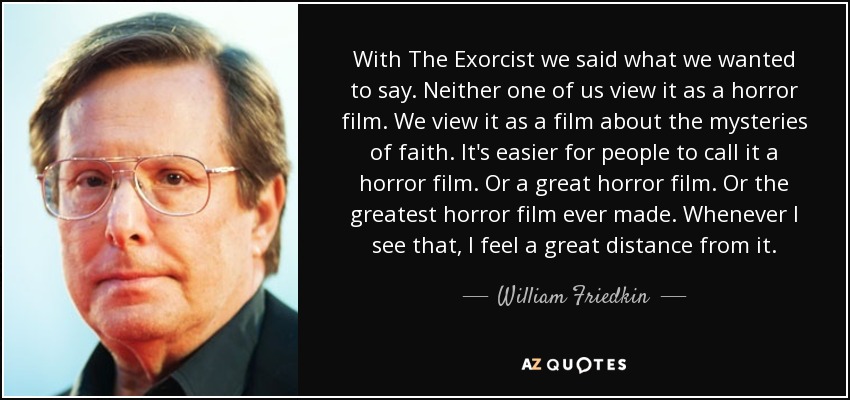
William Peter Blatty is often credited with creating one of the most commercially successful ‘horror’ novels, while William Friedkin directed the sensational film adaptation. Both express discomfort with the genre label ‘horror’ applied to their work: Blatty described his novel as a book-length sermon concerned with Faith in a world of great suffering. In the novel, Blatty borrows from an actual sermon delivered at the Catholic University of Ireland in 1856 by the priest, John Henry Newman:

We have familiar experience of the order, the constancy, the perpetual renovation of the material world which surrounds us. Frail and transitory as is every part of it, restless and migratory as are its elements, never-ceasing as are its changes, still it abides. It is bound together by a law of permanence, it is set up in unity; and, though it is ever dying, it is ever coming to life again. Dissolution does but give birth to fresh modes of organization, and one death is the parent of a thousand lives. Each hour, as it comes, is but a testimony, how fleeting, yet how secure, how certain, is the great whole. It is like an image on the waters, which is ever the same, though the waters ever flow. Change upon change—yet one change cries out to another, like the alternate Seraphim, in praise and in glory of their Maker. The sun sinks to rise again; the day is swallowed up in the gloom of the night, to be born out of it, as fresh as if it had never been quenched. Spring passes into summer, and through summer and autumn into winter, only the more surely, by its own ultimate return, to triumph over that grave, towards which it resolutely hastened from its first hour. We mourn over the blossoms of May, because they are to wither; but we know, withal, that May is one day to have its revenge upon November, by the revolution of that solemn circle which never stops—which teaches us in our height of hope, ever to be sober, and in our depth of desolation, never to despair.

~John Henry Newman

Over the years, when I have mentioned The Exorcist as a book that I greatly enjoyed in my youth, it has been my experience that people look askance and judge my appreciation based on what they know of the film adaptation, including graphic and offensive language spoken by a demonically possessed child. If we consider novels in terms of Wayne Booth’s metaphor of ‘Books as Friends’, we might ask ourselves, “How do you tell the good guys from the bad guys?” (Rhetoric of Fiction, 457) or “Will I accept the author among the small circle of my true friends?” (Company, 39). We ask, in a sense, “Do you, my would-be friend, wish me well, or will you be the only one to profit if I join you?” (Company, 178).

Is the novel, The Exorcist, our ‘friend’? Does the author seek to exploit the audience with psychological horror and graphic language? Is the novel troubling, disturbing or perhaps an edifying exploration of the mysteries of faith in a ‘vale of tears’?

I have often returned to a piece of dialogue from the novel, when the titular character, Father Merrin, (The Exorcist) explains his own view of ‘possession’:

I tend to see possession most often in the little things, Damien: in the senseless, petty spites and misunderstandings; the cruel and cutting word that leaps unbidden to the tongue between friends. Between lovers. Between husbands and wives. Enough of these and we have no need of Satan to manage our wars; these we manage for ourselves … for ourselves.”

Film Review Aggregators

Movie review aggregators have gained tremendous influence over the decision of whether or not moviegoers choose to pay to see a film in theatres, and yet the methods use to achieve scores for films by various aggregators tends to be poorly understood, so it’s easy to make a false assumption that a 70% audience score on Rotten Tomatoes should be understood as an average of all scores. This is not the case: Rotten Tomatoes “gives all positive reviews…a flat score of 1/1 and all negative reviews…a score of 0/1.”

Stop and think about that statement for a moment. A review of 5 stars, 4.5 stars, 4 starts, 3.5 stars, 3 stars, and 2.5 stars are all converted to a single point. However, an analysis of RT scores concluded the aggregator does not include the lowest possible rating of a 0.5 star review in it’s scoring algorithm. This means anyone who gives a film what is ostensibly the lowest possible score get excluded from the overall audience score.

A score anywhere between 1 and 2 stars is converted to zero, while 2.5 converts to a score of 1.

The RT algorithm strips away any question of, “How much did you like this film” and renders your score into a simple thumbs up / thumbs down evaluation, but it excludes the most negative reviews without being transparent about it.

The final RT audience score is a percentage of the reviews that were ‘positive’, while skewing data by blocking any zero star reviews and ignoring all the 0.5 star reviews.

A good question to ask might be, “Why?” And important factor to understand is that the parent company that owns Rotten Tomatoes is Fandango, a ticket-selling company owned by another company that happens to own production companies like Warner Brothers.

Should we be suspicious of review aggregators? There’s is an argument to be made for great writers who love cinema and can articulate why or when a film is worth seeing.

Holocene, by Bon Iver

Someway, baby, it’s part of me, apart from me
You’re laying waste to Halloween
You effed it friend, it’s on its head, it struck the street
You’re in Milwaukee, off your feet

And at once, I knew I was not magnificent
Strayed above the highway aisle
Jagged vacance, thick with ice
But I could see for miles, miles, miles

3rd and Lake, it burnt away, the hallway
Was where we learned to celebrate
Automatic bought the years you’d talk for me
That night you played me Lip Parade
Not the needle, nor the thread, the lost decree
Saying nothing, that’s enough for me

And at once, I knew I was not magnificent
Hulled far from the highway aisle
Jagged vacance, thick with ice
But I could see for miles

Christmas night, it clutched the light, the hallow bright
Above my brother, I and tangled spines
We smoked the screen to make it what it was to be
Now to know it in my memory

And at once, I knew I was not magnificent
High above the highway aisle
Jagged vacance, thick with ice
But I could see for miles