
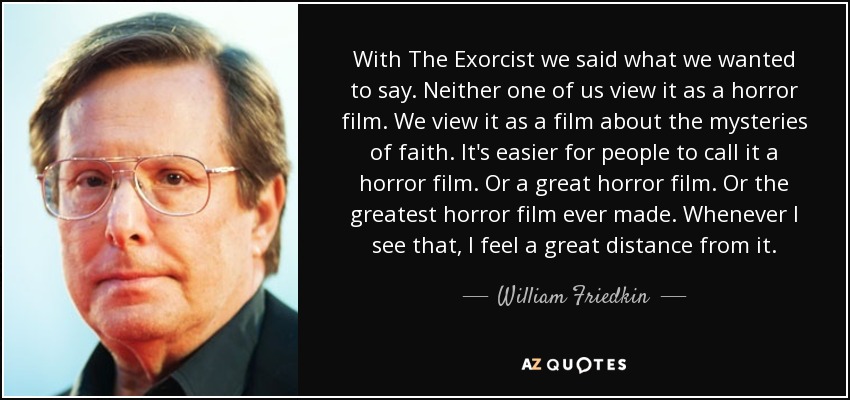
William Peter Blatty is often credited with creating one of the most commercially successful ‘horror’ novels, while William Friedkin directed the sensational film adaptation. Both express discomfort with the genre label ‘horror’ applied to their work: Blatty described his novel as a book-length sermon concerned with Faith in a world of great suffering. In the novel, Blatty borrows from an actual sermon delivered at the Catholic University of Ireland in 1856 by the priest, John Henry Newman:
We have familiar experience of the order, the constancy, the perpetual renovation of the material world which surrounds us. Frail and transitory as is every part of it, restless and migratory as are its elements, never-ceasing as are its changes, still it abides. It is bound together by a law of permanence, it is set up in unity; and, though it is ever dying, it is ever coming to life again. Dissolution does but give birth to fresh modes of organization, and one death is the parent of a thousand lives. Each hour, as it comes, is but a testimony, how fleeting, yet how secure, how certain, is the great whole. It is like an image on the waters, which is ever the same, though the waters ever flow. Change upon change—yet one change cries out to another, like the alternate Seraphim, in praise and in glory of their Maker. The sun sinks to rise again; the day is swallowed up in the gloom of the night, to be born out of it, as fresh as if it had never been quenched. Spring passes into summer, and through summer and autumn into winter, only the more surely, by its own ultimate return, to triumph over that grave, towards which it resolutely hastened from its first hour. We mourn over the blossoms of May, because they are to wither; but we know, withal, that May is one day to have its revenge upon November, by the revolution of that solemn circle which never stops—which teaches us in our height of hope, ever to be sober, and in our depth of desolation, never to despair.
~John Henry Newman
Over the years, when I have mentioned The Exorcist as a book that I greatly enjoyed in my youth, it has been my experience that people look askance and judge my appreciation based on what they know of the film adaptation, including graphic and offensive language spoken by a demonically possessed child. If we consider novels in terms of Wayne Booth’s metaphor of ‘Books as Friends’, we might ask ourselves, “How do you tell the good guys from the bad guys?” (Rhetoric of Fiction, 457) or “Will I accept the author among the small circle of my true friends?” (Company, 39). We ask, in a sense, “Do you, my would-be friend, wish me well, or will you be the only one to profit if I join you?” (Company, 178).
Is the novel, The Exorcist, our ‘friend’? Does the author seek to exploit the audience with psychological horror and graphic language? Is the novel troubling, disturbing or perhaps an edifying exploration of the mysteries of faith in a ‘vale of tears’?
I have often returned to a piece of dialogue from the novel, when the titular character, Father Merrin, (The Exorcist) explains his own view of ‘possession’:
I tend to see possession most often in the little things, Damien: in the senseless, petty spites and misunderstandings; the cruel and cutting word that leaps unbidden to the tongue between friends. Between lovers. Between husbands and wives. Enough of these and we have no need of Satan to manage our wars; these we manage for ourselves … for ourselves.”